
Mental Training for Powerbreaking: Kevin Jansen on Focus, Confidence & Pressure

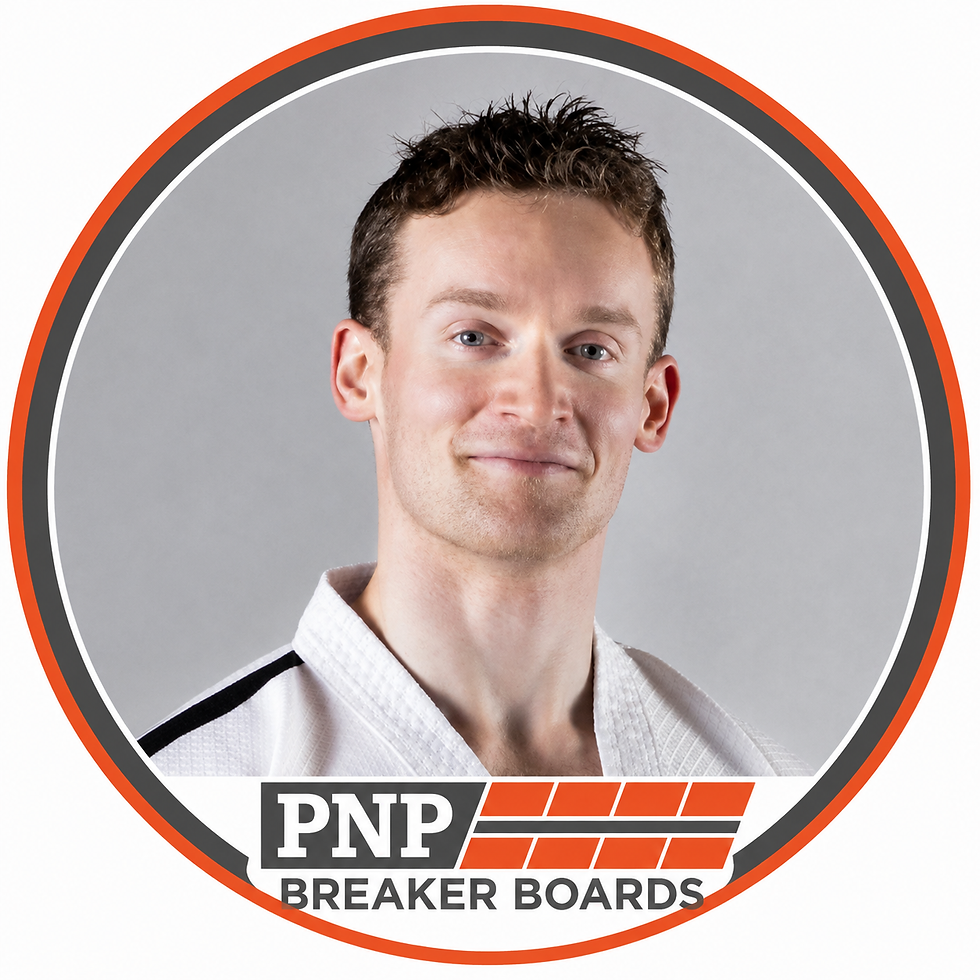
Meet Kevin Jansen – ITF World Cup Powerbreaking Champion
Hi everyone! My name is Kevin Jansen, a IV-degree black belt from the Netherlands, current I.T.F. (Spain / GM Weiler Group) World Cup Champion in Powerbreaking and proud PNP Breaker Boards sponsored athlete.
From 28 September to 4 October 2026, I will be in Benidorm, Spain, competing at the 10th I.T.F. World Cup to defend my title.
Throughout this series, I've been sharing different aspects of my World Cup powerbreaking preparation, including my training routine, training equipment, powerbreaking technique and strength training.
You can also follow me on Instagram at @ironfistETN, where I regularly post informative videos about my preparation.
In my last episode, I mentioned what I consider the three main aspects of powerbreaking:
Technical
Physical
Mental
We've talked a lot about the first two.
Now it's time to look at the third.
Why Mental Training for Powerbreaking Matters
Previously, I said that technical, physical and mental is also roughly the order of importance in training.
But I want to clarify what I mean by that.
For me, mental training for powerbreaking isn't about spending hours trying to force myself into the right mindset. It's about developing the focus, confidence and routine that allow me to perform at my best when it matters.
In terms of actual training time, it's probably true. Technical and strength training can each take several hours a week depending on your individual priorities, with technical training generally giving you more direct gains in terms of breaking performance.
At the highest international level, however, things become more interesting.
You can expect the best athletes in a category to have developed both their technique and physical capabilities to a very high standard.
The margins become smaller.
So… what makes the difference between winning gold and silver?
Or between reaching the podium and finishing somewhere in the top five?
I've actually asked some of the best powerbreakers in the world to describe their greatest competition moments.
None of them started by talking about strength.
None started by explaining their technique.
They talked about their state of mind on the day.
Finding the Mental Sweet Spot
The mental aspect of training is much harder to quantify.
Your focus and mindset can transform your performance positively or negatively, and your state of mind can also directly affect what your body does.
For me, the ideal state immediately before a break is:
A focused mind and a relaxed body.
That's the mental sweet spot.
Too much focus can cause the body to tense.
When that happens, movements can become stiff and the athlete may concentrate too heavily on hitting or kicking as hard as possible, relying on brute strength rather than acceleration.
There can even be physical signs: raised shoulders, a tense jaw or holding your breath.
But too little focus causes a different problem.
Accuracy can suffer. You can mistime the point of acceleration, leave power on the table or simply aim too high or too low.
So… the objective isn't simply to become more focused.
It's to find the right level of focus.
My Mental Routine Before a Competition Break
My method for reaching that mental sweet spot is based heavily on routine.
And it starts from the moment I measure the break.
When I'm measuring, I never focus on how many boards are in front of me.
I'm simply extending my attacking tool towards a target.
As I step backwards, I visualise the explosiveness of the technique rather than visualising myself hitting a stack of boards.
Once I reach my starting position in guarding block, as required under I.T.F. Spain rules, I take a deep breath.
I deliberately allow my chest and shoulders to move up and down with that breath. It helps prevent stiffness and tension from building.
Then comes something quite deliberate.
I take only a quick glance in the general direction of the boards.
I purposely don't describe this as looking at the boards.
Why?
Because I don't want the number of boards entering my subconscious.
Whether there are six boards or one shouldn't change the assignment.
They're simply a target.
My job is to deliver the technique as powerfully and effectively as I can.
I begin moving at a relaxed tempo until I reach the point of acceleration.
At that moment, my focus switches completely towards delivering an explosive technique.
Competition Confidence Is Built Months Earlier
Everything I've described so far happens within seconds.
But the mindset you take into competition isn't created during those few seconds.
It starts months earlier.
During training, building and protecting confidence is incredibly important because subconsciously your mind will refer back to those training experiences when you're competing.
That's one reason why I place so much importance on being consistently successful at least at the competition entry-level number of boards.
Once you've completed a perfect first round, you've given yourself something positive to build on as you move into the tiebreaker rounds.
How I Build Confidence During Training
If you've followed the previous episodes, you'll recognise several of the methods I use:
Protective equipment, so I can fail more safely.
Volume training, to develop routine and consistency.
Incremental increases in board numbers, rather than making unnecessarily large jumps.
You can read more about how I put these methods into practice in Phase 2 of my World Cup powerbreaking training.
These aren't only physical training strategies.
They're confidence-building strategies too.
Every successful repetition gives my mind another positive experience to draw upon later.
Why I Film My Best Training Breaks
There's another technique I use which is incredibly simple.
I film my breaks.
Obviously, video is useful from a technical point of view. I can compare successful and unsuccessful attempts and look for differences.
But I also use the footage for something completely different.
Throughout the season I save videos of my most impressive training breaks.
Then, roughly a week before a major competition, I put them together into a compilation.
I add some energising music, share the video on social media and keep watching and mentally reliving those successful breaks during the days leading up to competition.
For me, this helps enormously with visualisation and confidence building.
I'm not trying to convince myself that something might be possible.
I'm repeatedly showing myself evidence of what I've already done.
Always Looking for Something New
One thing I've learned throughout my sporting career is never to assume that I have nothing left to learn.
As soon as I adopt that attitude, progress stops.
In my early twenties, I trained with bodybuilders, Strongman athletes and coaches to improve my understanding of strength training.
I've shared more about how strength work fits into my World Cup preparation in How a World Champion Builds Strength for Powerbreaking.
From my mid-twenties onwards, I've tried to train with as many World Champion powerbreakers as possible – even going as far as flying Brendan Doogan and Wesley Filiki from New Zealand to the Netherlands, with Brendan making the trip on several occasions.
For my 2026 World Cup campaign, I decided to explore the mental side of performance further.
It's an area where I feel I still have more to discover, and potentially more performance gains to find.
Experimenting with Neurofeedback Training
Through a long-time Strongman friend, I was introduced to Braindoc.nl, a clinic specialising in neurofeedback training.
The idea behind the system, as it was explained to me, is to look at patterns of electrical activity in the brain and use neurofeedback training to encourage a more balanced brainwave pattern.
From a sporting perspective, the areas that particularly interested me were concentration and the possible relationship between brain activity and the signals involved in muscular performance.
After an introduction to their approach, I scheduled a brainwave analysis followed by my first neurofeedback training session.

For me, this was very much an experiment within my World Cup preparation rather than a replacement for any of my normal technical, physical or mental training.
Establishing a Strength Baseline
Before my first appointment, I was asked to establish a strength baseline.
I selected five machine-based exercises with movement patterns that I felt had some relevance to my preferred World Cup techniques – the sidekick and punch:
· Leg press
· Abdominal rotation
· Chest press
· Reverse fly
· Triceps extension
I performed a sub-maximal test 72 hours before the neurofeedback session, using a weight that I could lift for approximately three to six repetitions.
The results could then be used to estimate my one-repetition maximum (1RM) and provide a baseline against which later testing could be compared.
The purpose wasn't simply to see whether I felt different after neurofeedback.
I wanted some measurable physical data that could be compared before and after the session.
What Did the Brainwave Analysis Measure?
For the initial analysis, I completed a series of cognitive tasks while equipment measured the electrical activity associated with my brainwaves.

The results were then interpreted by the clinic in relation to different types of brainwave activity:
Delta waves – the slowest brainwaves, most strongly associated with deep, dreamless sleep and physical recovery.
Theta waves – slower activity associated with states such as light sleep, deep relaxation, daydreaming and meditation, and often linked with memory and creativity.
Alpha waves – commonly associated with being awake but calm and relaxed; essentially a more restful state of brain activity.
Beta waves – faster activity associated with normal waking consciousness, alertness, active thinking, concentration and problem-solving. Higher levels can also be associated with stress or anxiety.
Gamma waves – the fastest of these brainwave patterns, associated with intense focus and higher-level cognitive processing.

What interested me was that neurofeedback wasn't simply about trying to produce more brain activity.
In much the same way that I don't want maximum physical tension immediately before a break, the objective was to look at the balance between different types of activity and identify where my individual pattern differed from the target pattern being used by the clinic.
That fitted surprisingly well with the way I already think about competition breaking.
As I've explained earlier, my ideal state is not maximum focus at all costs.
I want a focused mind and relaxed body.
Too much tension can be just as detrimental as too little concentration.

How Did the Neurofeedback Training Work?
Following the analysis, the clinic formulated an individual training protocol based on its interpretation of my brainwave activity.
The neurofeedback session itself lasted approximately 45 minutes.
During the session I watched a film through a visual display. The display responded to the feedback being measured, changing its size and appearance according to my brain activity.
The idea was that this visual feedback would encourage my brain towards the patterns targeted by the training protocol.
Rather than consciously trying to control individual brainwaves, I simply watched the film while the system provided the feedback.
Alongside the neurofeedback session, I was also given a supplement plan containing specific amino acids which, according to the clinic's protocol, were intended to support the processes involved in communication between the brain and muscles.
Within 24 hours of the session, I repeated the sub-maximal strength tests so that the results could be compared with my original baseline.
Did Neurofeedback Improve My Performance?
This is where I want to be cautious.
I experienced a marginal increase in performance during the follow-up strength testing. For example, I was able to use higher loads in several of the exercises than during my baseline session.
However, at the time of writing, the effect on my estimated one-repetition maximum was still being calculated.
More importantly, one test isn't enough for me to conclude that neurofeedback caused an improvement.
There are plenty of variables that can affect performance from one strength session to another, and I don't want to mistake an interesting result for proof of cause and effect.
And even if further testing suggests an improvement in strength, there's another question that matters much more to me:
Does it transfer to better powerbreaking performance?
That's ultimately the test.
The purpose of all my preparation, whether technical, physical or mental… is to perform better when I'm standing in front of the boards.
So, at this stage, I consider neurofeedback an interesting concept that I'm experimenting with rather than something I'm presenting as a proven performance solution.
I'll continue exploring it during the remainder of my World Cup preparation and see whether any changes I observe in testing ultimately translate into what really matters: my performance on the boards.
Entering the Final Month
As I'm writing this, we're moving into September.
That means I've entered the final month before the World Cup.
I'm approaching peak shape, and from here my training sessions will become increasingly intuitive, adapting to what I need at that particular moment rather than simply following a rigid programme.
Over the last few months, I've worked on technique.
I've worked on strength.
I've worked on consistency, intensity and explosiveness.
And now I'm paying closer attention to the mental side of performance too.
Because when the margins between athletes become small, being physically capable of producing your best performance is only part of the challenge.
You still have to produce it when it counts.
See you next time!
Frequently Asked Questions
How important is mental training for powerbreaking?
At the highest level, Kevin believes mental preparation can become increasingly important because leading athletes may already have highly developed technical and physical abilities. His aim is to achieve what he describes as a focused mind and relaxed body.
How does Kevin Jansen prepare mentally before a competition break?
Kevin uses a consistent routine involving measuring the break, visualising the explosiveness of the technique, controlling his breathing and avoiding focusing on the number of boards in front of him.
How does Kevin Jansen build confidence for powerbreaking competitions?
Kevin builds confidence through successful repetitions, volume training, protective equipment and gradual increases in board numbers. He also reviews footage of successful training breaks before major competitions to reinforce positive performances.
What is neurofeedback training?
In Kevin's World Cup preparation, neurofeedback involves measuring patterns of brainwave activity and using visual feedback as part of an individual training protocol. Kevin is exploring it experimentally alongside his normal technical, physical and mental preparation.
Has neurofeedback improved Kevin Jansen's powerbreaking performance?
Kevin observed a marginal improvement during follow-up strength testing, but he specifically says that one test is not enough to establish cause and effect. His key question is whether any changes ultimately transfer to improved powerbreaking performance.
Follow Kevin's Road to Benidorm
Kevin's World Cup preparation demonstrates how many different elements contribute to elite powerbreaking – from technique and strength to consistency, confidence and competition mindset.
PNP Breaker Boards is proud to support Kevin throughout his journey towards the 2026 I.T.F. World Cup in Benidorm.
Follow Kevin on Instagram: @ironfistETN
Train with the boards Kevin uses throughout his World Cup preparation:


Comments