
How a World Champion Builds Strength for Powerbreaking – Kevin Jansen’s World Cup Training

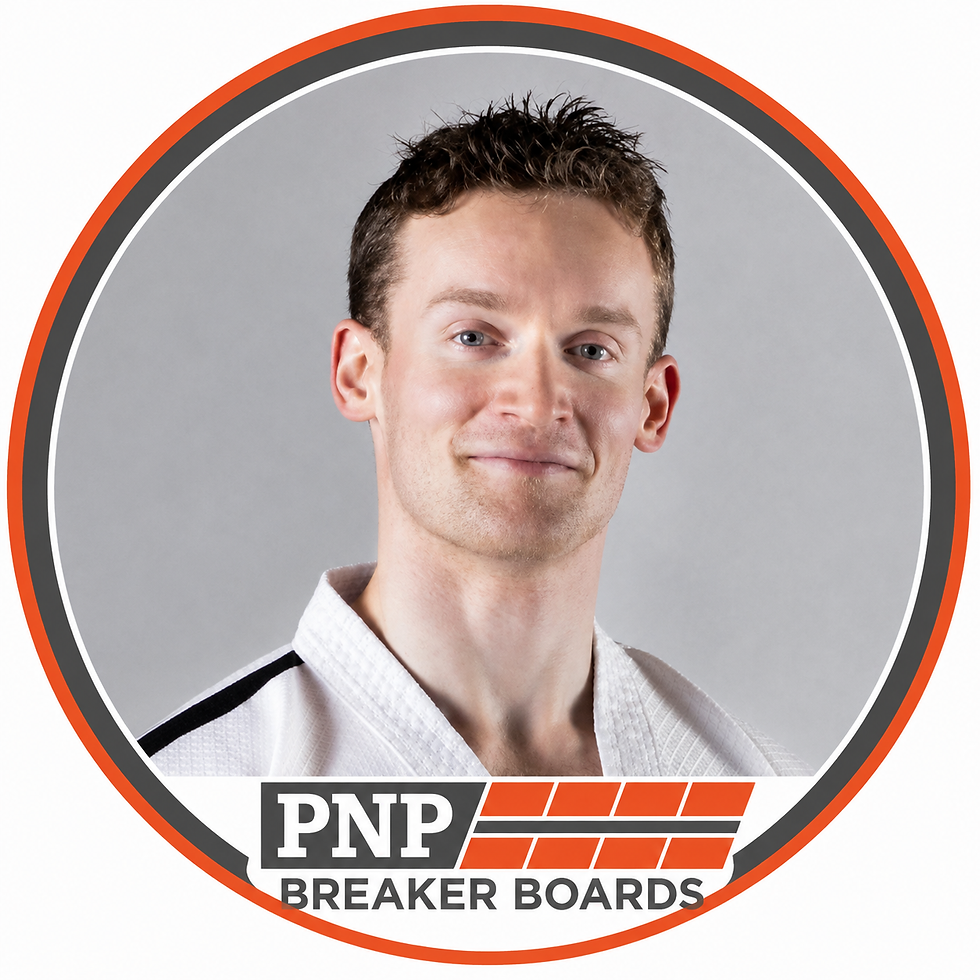
Meet Kevin Jansen – ITF World Cup Powerbreaking Champion
Hi everyone! My name is Kevin Jansen, a IV-degree black belt from the Netherlands, current I.T.F. (Spain / GM Weiler Group) World Cup Champion in Powerbreaking and proud PNP Breaker Boards sponsored athlete.
From 28 September to 4 October 2026, I will be in Benidorm, Spain, competing at the 10th I.T.F. World Cup to defend my title.
Throughout this series, I've been sharing different aspects of my World Cup powerbreaking preparation, including my training routine, training equipment, powerbreaking technique and the way my training changes as competition gets closer.
You can also follow my World Cup preparation on Instagram at @ironfistETN, where I regularly post informative videos about my preparation.
In the previous episodes, we've looked in detail at my actual powerbreaking training sessions. This time, we're going to step away from the boards and look at another important part of my preparation: strength training for powerbreaking.

The Three Sides of Powerbreaking Performance
There are three aspects to powerbreaking – or really any competitive sport when you think about it:
The technical aspect
The physical aspect
The mental aspect
For powerbreaking, I would say that is also the order of importance in our training.
Technique reigns supreme.
Your technical execution is the tool through which you transfer your power into the target. You can think of technique as a multiplier: strength is the input, while your actual breaking power is the output.
Let me illustrate what I mean.
Strength × Technique = Breaking Power
This is a deliberately simplified way of looking at the relationship between strength and technique.
Let's call:
S = Strength – our physical input.
T = Technique – our multiplier. For the purposes of this example, it can range from 0, where no useful technique reaches the boards, to 1, representing perfect transfer of our strength into the target.
BP = Breaking Power – the actual impact of our attacking tool on the target.
Now let's compare three examples:
Example | Strength (S) | Technique (T) | Breaking Power (BP) |
1 | 100 | 0.80 | 80 |
2 | 125 | 0.60 | 75 |
3 | 125 | 0.64 | 80 |
What does this show us?
Comparing examples one and two, increasing strength by 25% hasn't compensated for a 25% decrease in technical execution.
Example three shows that even with 25% more strength, we still need a reasonable level of technical execution to produce the same breaking power as example one.
In simple terms:
Technique > Strength
But there is another important point.
At some stage, a sufficiently large increase in strength can compensate for a difference in technique.
A Theory Based on Experience – Not a Scientific Formula
I want to make it clear that this is a very simplified and scientifically unsupported way of demonstrating the relationship between strength and technique.
I don't have the exact scientific numbers.
From my experience, however, improvements in technical execution can have a much greater effect on breaking power than a similar improvement in strength.
But that doesn't make strength unimportant.
In a competitive situation, an athlete with inferior technique may still be able to break more boards if their strength is sufficient to compensate for the difference in technical execution.
And this becomes particularly important at the highest level.
Why Strength Matters at World-Level Powerbreaking
When we're approaching the medal positions in an elite competition, the differences in technical execution between athletes are unlikely to be enormous.
That means a serious competitor with medal ambitions can't afford to leave one aspect of their powerbreaking preparation on the table.
Technique remains my priority.
But once technique reaches a high level, improving the physical input behind that technique gives us another opportunity to improve the output.
So with that rather elaborate introduction, let me show you what I actually do for my strength training.
Strength Training for Powerbreaking: Building Raw Strength and Muscle Mass
During June and July, my World Cup training works on a two-week cycle.
Alongside my powerbreaking and mobility sessions, my strength training is divided between:
Legs – squats and hamstring work.
Anterior chain – chest, front shoulders and triceps
Posterior chain – back, rear shoulders and biceps
There are several key points behind the way I structure this:
I train my entire body once a week.
The split is determined primarily by movements rather than individual muscles: Push, Pull and Legs.
I concentrate on compound exercises including squats, bench press, barbell rows and overhead presses.

During the early months of preparation, I follow a more standardised, powerlifting-style routine designed to build basic strength and muscle mass.
After a number of warm-up sets, I'll generally perform three to five working sets, depending on the exercise.
At this stage, I use a weight that allows me to perform approximately six to eight repetitions per working set.
The objective here is straightforward: Build the physical foundation first.
Phase 2: Turning Strength into Explosive Power
As I move into August and the first half of September, the emphasis begins to change across both my strength work and my Phase 2 powerbreaking training.
The main difference in my strength training during Phase 2 is the introduction of plyometric exercises.

In some cases, that means transforming exercises I've already been performing – such as the squat and bench press – into more explosive versions by adding resistance bands.
Why?
Because adding the bands increases the resistance towards the top of the movement.

That forces me to keep accelerating through the movement rather than slowing down as I approach the top.
And that acceleration is exactly what I'm trying to produce when I perform a powerbreaking technique.
Training for a Single Explosion of Power
The transition into Phase 2 doesn't mean abandoning everything I've done previously.
The number of working sets remains the same.
What changes is the number of repetitions.
Instead of working predominantly in the six-to-eight-repetition range, I reduce this to approximately three to six repetitions per set.
The purpose is to shift the emphasis towards the type of explosive output I need for my punch or kick.
Powerbreaking doesn't ask me to produce moderate force repeatedly over a long period.
When I'm standing in front of the boards, I need to generate a single explosion of power and transfer it efficiently through the target.
So as the World Cup gets closer, my strength training needs to reflect that demand.
Technique Still Comes First
This brings us back to where we started.
Strength training is an essential part of my preparation, but simply becoming stronger isn't enough.
Technical execution is what allows us to unlock and transfer the power already stored within our bodies.
Without input, there can be no output.
But without effective technique, we can't make the best use of that input either.
For me, that's why strength and technique shouldn't be viewed as competing ideas.
The goal is to develop both – while understanding the role each one plays.
What Progressive Resistance Can Teach Us About Breaking
There is also another benefit to incorporating mechanics such as progressive resistance into strength training.
Using resistance bands forces me to think about accelerating through a movement.
That's a principle that transfers directly into my breaking technique.
I don't want to generate my maximum acceleration too early and then slow down as I reach the target.
I want to accelerate through the movement.
So strength training doesn't only help develop my physical capabilities.
Used correctly, it can also improve my understanding of how I want a powerbreaking technique to feel.
That's another reason why I consider it an important part of my World Cup preparation.
Building Towards Benidorm
The closer I get to Benidorm, the more specific the training becomes.
Phase 1 gave me the opportunity to build strength, muscle mass, technical consistency and a solid physical foundation.
Phase 2 is about taking those foundations and making them increasingly relevant to competition.
For my strength training, that means moving from general strength towards greater acceleration and explosiveness.
For my powerbreaking sessions, it means balancing consistency with the higher-intensity work needed to push towards my competition goals.
Everything is beginning to come together.
And with the World Cup getting closer, the focus is increasingly on turning months of preparation into performance when it matters.
See you next time!
Strength Training for Powerbreaking FAQs
What is strength training for powerbreaking?
Strength training for powerbreaking develops the physical force, acceleration and explosive power needed to support effective breaking techniques. Kevin combines compound strength exercises with more explosive movements as competition approaches, while continuing to prioritise technical execution.
Is strength or technique more important in powerbreaking?
Technique is the more important factor because it determines how efficiently an athlete transfers physical strength into the target. However, when athletes have similarly advanced technical ability, greater strength and explosive power can provide an important competitive advantage.
Which strength exercises help with powerbreaking?
Kevin’s programme includes compound exercises such as squats, bench presses, barbell rows and overhead presses. These exercises help build the overall strength and muscle mass that provide a physical foundation for powerbreaking.
Why does Kevin Jansen use resistance bands in his strength training?
Resistance bands increase the resistance towards the top of exercises such as squats and bench presses. This encourages Kevin to continue accelerating throughout the movement, reflecting the explosive acceleration he needs when punching or kicking through breaking boards.
How does strength training change as a powerbreaking competition approaches?
During the earlier phase of Kevin’s preparation, he uses a more standardised strength programme with approximately six to eight repetitions per working set. As the World Cup approaches, he reduces this to around three to six repetitions and introduces plyometric and resistance-band exercises to place greater emphasis on acceleration and explosive power.
Why is explosive power important in powerbreaking?
Powerbreaking requires an athlete to generate a concentrated explosion of force and transfer it efficiently through the target. Explosive training helps prepare the body for this type of short, powerful effort rather than prolonged or repetitive physical output.
Can strength training improve powerbreaking technique?
Strength training cannot replace dedicated technical practice, but some training methods can reinforce important technical principles. For example, progressive resistance teaches the athlete to accelerate through a movement rather than reaching maximum speed too early and slowing down before contact.
Follow Kevin's Road to Benidorm
Kevin's World Cup preparation demonstrates that elite powerbreaking is about far more than simply trying to break more boards.
Technique, strength, explosive power, consistency, recovery and progressive training all have a role to play.
Follow Kevin on Instagram: @ironfistETN
Train with the Boards Kevin Trusts
Kevin’s strength training helps build the physical foundations for powerbreaking, but transferring that strength effectively still depends on technique, repetition and consistent practice.
As a sponsored PNP Breaker Boards athlete, Kevin uses PNP’s reusable breaking boards throughout his preparation for the 2026 I.T.F. World Cup.
Whether you’re developing your first breaking techniques or preparing for competition, our different resistance levels allow you to progress safely, practise repeatedly and build greater confidence in your power.
Ready to put your strength and technique into practice?


Comments