
World Champion Powerbreaking Training: Kevin Jansen’s Phase 2

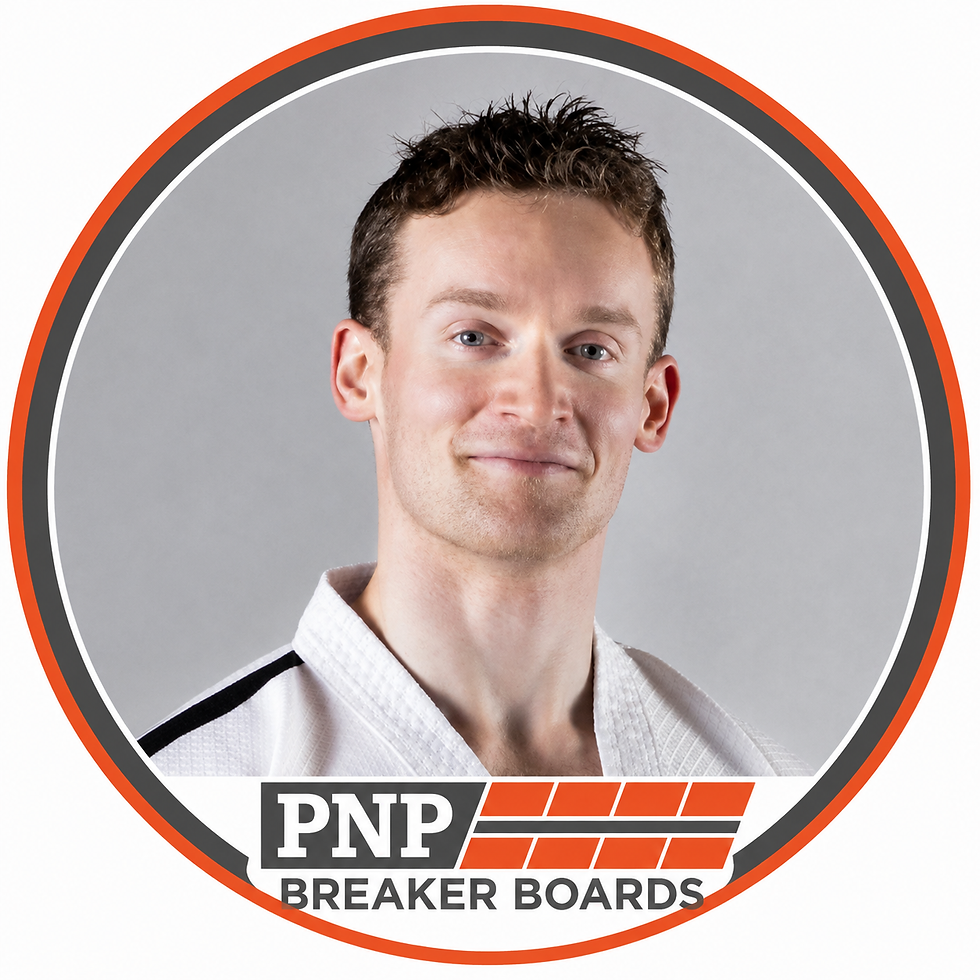
Meet Kevin Jansen – ITF World Cup Powerbreaking Champion
Hi everyone! My name is Kevin Jansen, a IV-degree black belt from the Netherlands, current I.T.F. (Spain / GM Weiler Group) World Cup Champion in Powerbreaking and proud PNP Breaker Boards sponsored athlete.
From 28 September to 4 October 2026, I will be in Benidorm, Spain, competing at the 10th I.T.F. World Cup to defend my title.
Throughout my preparation campaign, I'm sharing an inside look at my training routine, equipment, competition analysis, powerbreaking technique, strength training and mental preparation.
You can also follow my World Cup preparation on Instagram at @ironfistETN
In my previous article, I took you inside Phase 1 of my powerbreaking training, where the focus was primarily on technical refinement, repetition and consistency.
Now it's time for Phase 2.
And this is where things start getting serious.
Phase 2: From Consistency to Peak Performance
Phase 1 laid the foundations.
During Phase 2 – August through to the first half of September – the objective is to make bigger steps towards peak performance.
We've established consistency. Now it's time to gradually and responsibly push the boundaries.
The training sessions become much more varied and intuitive.
At the beginning of a session, I'm not always certain how far I'll go or exactly when I'll stop.
It takes experience to recognise the line between pushing your limits and overtraining.
That's something that differs from athlete to athlete and, in my experience, can only really be learned over years of training, experimentation and occasionally getting it wrong.
There will always be days when you're not performing at your best. You may be tired or showing the early signs of overtraining.
That doesn't mean the session has to be wasted.
You can still have a productive training session, provided you know how to adjust it.
How My Powerbreaking Training Changes in Phase 2
There are several important changes to my training programme as I move from Phase 1 into Phase 2.
Phase 1 – June & July
Powerbreaking: 4 sessions every two weeks
Primary focus: Volume and muscle memory
Strength training: Legs, anterior chain and posterior chain
Mobility: Explosiveness, core and stretching
Rest: 2 rest days per two-week cycle
Phase 2 – August to Mid-September
Powerbreaking: 5 sessions every two weeks
Primary focus: Combination of intensity and volume
Strength training: Legs, anterior and posterior chain, with plyometrics added
Mobility: Explosiveness, core and stretching
Rest: 1 rest day per two-week cycle
Training routine June-July
Day | Type of training | Subject of training | Details |
1 | Powerbreaking | Sidekick & Punch | Focus on volume for muscle memory |
2 | Strength | Leg day | Squats & hamstring work |
3 | Strength | Anterior chain | Chest/(front)shoulders/triceps |
4 | Powerbreaking | Sidekick & turning kick | Focus on volume for muscle memory |
5 | Rest |
|
|
6 | Mobility | Movement | Explosiveness, core, stretching |
7 | Strength | Posterior chain | Back/(back)shoulders/biceps |
8 | Powerbreaking | Sidekick & Knifehand | Focus on volume for muscle memory |
9 | Strength | Leg day | Squats & hamstring work |
10 | Strength | Anterior chain | Chest/(front)shoulders/triceps |
11 | Powerbreaking | Sidekick & Reverse turning kick | Focus on volume for muscle memory |
12 | Rest |
|
|
13 | Mobility | Movement | Explosiveness, core, stretching |
14 | Strength | Posterior chain | Back/back)shoulders/biceps |
Training routine August- first half of September
Day | Type of training | Subject of training | Details |
1 | Powerbreaking | Sidekick & Punch | Focus on intensity for sidekick and punch |
2 | Strength | Leg day | Squats & hamstring work including plyometrics |
3 | Strength | Anterior chain | Chest/(front)shoulders/triceps, including plyometrics |
4 | Powerbreaking | Knifehand & turning kick | Focus on volume for muscle memory |
5 | Strength | Posterior chain | Back/(back)shoulders/biceps |
6 | Mobility | Movement | Explosiveness, core, stretching |
7 | Powerbreaking | Sidekick & reverse turning kick | Focus on volume for sidekick and RTK |
8 | Strength | Anterior chain | Chest/(front)shoulders/triceps, including plyometrics |
9 | Powerbreaking | Sidekick & punch | Focus on intensity for sidekick and volume for punch |
10 | Strength | Leg day | Squats & hamstring work, including plyometrics |
11 | Strength | Posterior chain | Back/back shoulders/biceps |
12 | Powerbreaking | Knifehand & turning kick | Focus on volume for muscle memory |
13 | Mobility | Movement | Explosiveness, core, stretching |
14 | Rest day |
|
|
Volume vs Intensity in Powerbreaking Training
One of the most important differences in Phase 2 is understanding the distinction between volume training and intensity training.
Volume training
The aim is to maintain and improve consistency – at least at competition entry level.
This involves more repetitions and gives me the opportunity to reinforce technique and muscle memory.
Intensity training
This is where I'm chasing records.
Rest periods between attempts become longer, while the total number of attempts for that particular technique decreases.
That gives me more opportunity to recover both physically and mentally before another maximum or near-maximum attempt.
During Phase 2, I schedule:
Sidekick intensity training once per week
Punch intensity training once every two weeks
The difference is largely due to recovery. My hands require significantly more recovery than my feet.
Sidekick / Yop Chagi Intensity Training
If you've read my previous blog, you'll already know what the progression of my volume sessions looks like.
The principle remains the same throughout Phase 2 because I'm still working to increase consistency at higher board numbers.
The difference comes with my intensity sessions.
These sessions are much more fluid and depend heavily on how I'm performing on the day.
The objective is to push towards new personal records over the course of Phase 2 – but that doesn't mean attempting a new record at every session.
Training responsibly and avoiding injury are still priorities.
I often think about something my powerbreaking mentor, 2013 World Champion Sabum Brendan Doogan, taught me:
"If you're on a roll, keep rolling. If it stops working, stop working!"
That's a very good summary of how I approach these sessions.
My Sidekick Progression
Sidekick Session no. | Warm-up set 1 2 x 4 boards | Warm-up set 2 1 x 4.5 boards | Work-set 1 1-3 x 5 boards | Work-set 2 1-3 x 5.5 boards | Work-set 3 1-3 x 6 boards | Work-set 4 1-3 x 6 boards |
Example | V V | V | O V | X X V | O X O | V |
1 |
|
|
|
|
|
|
2 |
|
|
|
|
|
|
Etc. etc. |
|
|
|
|
|
|
The important thing for readers to understand is how the sets change.
Board numbers where I approached a 100% success rate during Phase 1 now become warm-up sets.
My working sets then progress towards:
5 boards → 5.5 boards → 6 boards

Kevin explains that above four boards, he may use different combinations of white, black and half boards. For his own training calculations, he treats one black PNP board as equivalent to 1.5 white competition boards.
I’ve previously explained why consistency and predictable resistance in breaking boards matter so much when training at competition level.
The Rule of Three
My work sets during an intensity session are designed to build confidence rather than simply exhaust me.
I use what I call the Rule of Three.
At each board level, I make a maximum of three attempts to achieve a full break.
Full break
As soon as I achieve a full break, I stop that set and move up to the next number of boards.
Three failed attempts
If I fail three times with zero points, I either reduce the number of boards or stop completely.
Partial breaks
If I achieve a combination of failures and partial breaks, I'll generally perform another set at the same number of boards.
This helps me push the limits without allowing an intensity session to become an uncontrolled series of maximum attempts.
Kevin's Powerbreaking Training Tips
There are several things I've learned from these sessions that are worth remembering.
1. A partial break can still be a record
Don't dismiss a partial break.
If you're working above competition entry level, even a single point can potentially make the difference in your category.
Treat progress as progress.
2. Finish on a successful break
I always recommend finishing with a successful break, even if that means dropping back to the starting number of boards.
It's a simple psychological technique:
Leave the session on a success.
3. You won't break records every session
Don't become frustrated because you haven't matched or beaten your personal best.
Nobody pushes their boundaries every single training session.
If the records aren't falling that day, change the objective.
Turn it into a consistency session instead.
For anyone developing their own breaking technique, our step-by-step guide to breaking a board properly covers the fundamentals of technique, accuracy and progression.
Forefist Punch / Ap Joomuk Intensity Training

My punch intensity sessions follow essentially the same principles as the sidekick.
The main difference is frequency.
Punch intensity sessions are deliberately less frequent to reduce the risk of hand injuries and provide adequate recovery.
At higher board numbers, I also prefer to perform single attempts.
This helps prevent overtraining and allows me to maintain concentration throughout the session.
Punch Session no. | Warm-up set 1 3 x 1 board | Warm-up set 2 1 x 2 boards | Work-set 1 1 x 3 boards | Work-set 2 1 x 3.5 boards | Work-set 3 1 x 3.5 boards | Work-set 4 1 x 3.5 boards |
Example | V V V | V | V | X | O | O |
1 |
|
|
|
|
|
|
2 |
|
|
|
|
|
|
Etc. etc. |
|
|
|
|
|
|
Kevin's progression is:
Warm-up: 1 board → 2 boards
Working sets: 3 boards → 3.5 boards
Kevin deliberately uses single attempts at the higher numbers to maintain focus and reduce the risk of overtraining.
Phase 2 Progress So Far
At the time of writing, it's mid-August and Phase 2 has only just begun.
But I've already matched my previous record of a six-board sidekick.
I've also achieved a new result of four points on a 3.5-board punch.
My main objective remains the four-board punch.
A partial break at 6.5 or seven boards with my sidekick would also represent a major milestone.
But records aren't the only measure of progress.
If I can significantly improve my consistency at five and six boards, I'll consider that a successful Phase 2 as well.
What's Next?
The powerbreaking sessions are only one part of my World Cup preparation.
In the next two blog episodes, we're going to step away from the boards temporarily and look at another crucial part of the process:
Strength training.
I'll show you how my strength sessions support my powerbreaking performance as the World Cup gets closer.
See you then!
Frequently Asked Questions
What is intensity training in powerbreaking?
Intensity training focuses on attempting higher board numbers and pushing towards personal records. Kevin increases the recovery time between attempts and reduces the total number of attempts so he can recover physically and mentally.
What's the difference between volume and intensity training?
Kevin uses volume training to develop consistency, repetition and muscle memory, while intensity sessions are used to push his maximum performance and attempt higher board numbers.
How often does Kevin Jansen train powerbreaking?
During Phase 2, Kevin completes five powerbreaking sessions within each two-week training cycle, compared with four during Phase 1.
What is Kevin Jansen's Rule of Three?
During an intensity working set, Kevin allows himself a maximum of three attempts to achieve a full break. A successful full break means progressing to the next level, while three failures may mean reducing the board number or ending the session.
Why does Kevin train his punch less frequently than his sidekick?
Punch intensity sessions require greater recovery because of the potential stress and injury risk to the hands. Kevin therefore schedules punch intensity work less frequently than sidekick intensity training.
What is Kevin Jansen's current sidekick record?
At the time of writing, Kevin had matched his previous six-board sidekick record during the early stages of Phase 2. His longer-term goal is to attempt a partial break at 6.5 or seven boards while improving his consistency at five and six boards.
Ready to Push Your Own Breaking Limits?
Kevin's Phase 2 training demonstrates that progressing in power breaking isn't simply about attempting more boards.
It's about consistency, controlled progression, technique and knowing when to push and when to stop.
PNP Breaker Boards provide a reusable training system with different resistance levels, allowing martial artists to progressively challenge their breaking ability as their technique, confidence and power develop.
Think you're ready for the next level?
Follow Kevin's Road to Benidorm


Comments