
Why I Choose PNP Breaker Boards for World Cup Powerbreaking Training

Updated: Sep 4
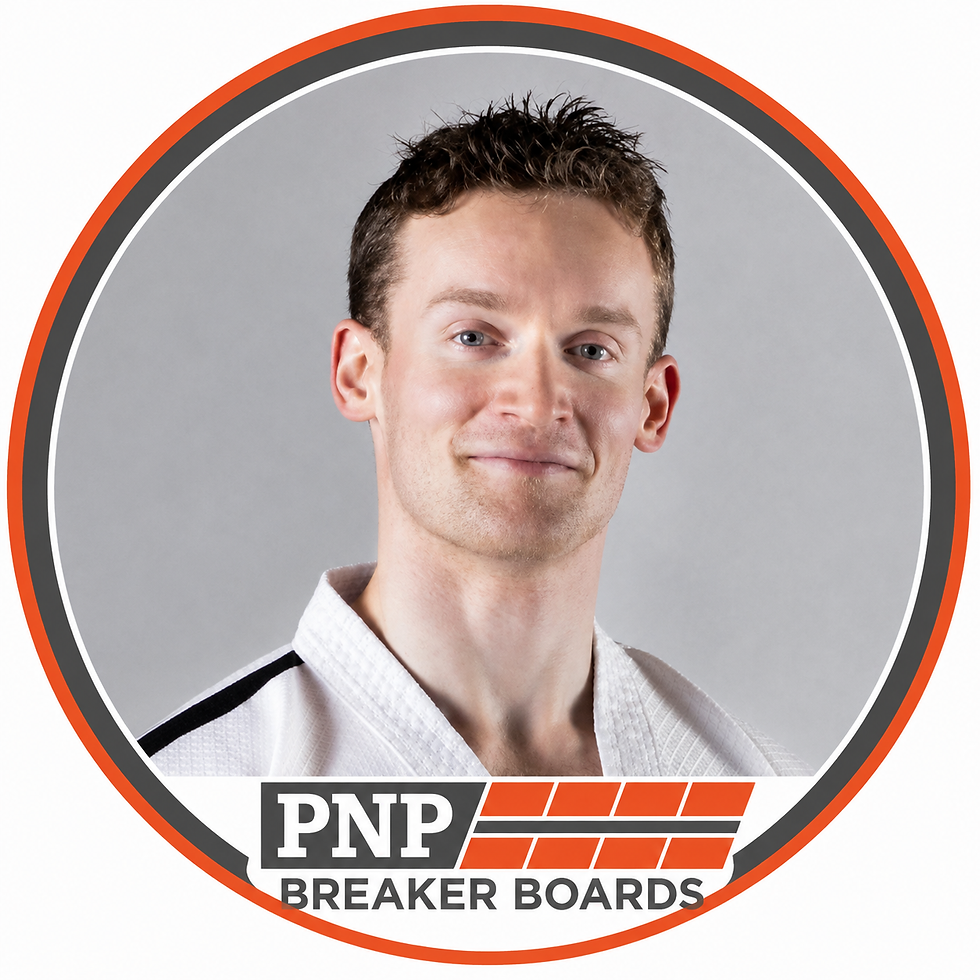
Meet Kevin Jansen – ITF World Cup Powerbreaking Champion
Hi everyone! My name is Kevin Jansen, IV-degree black belt from the Netherlands, current I.T.F. (Spain / GM Weiler Group) World Cup Champion in Powerbreaking and proud PNP Breakerboards sponsored athlete. From September 28th until October 4th 2026 I will be in Benidorm Spain to compete at the 10th I.T.F. World Cup to defend my title.
In the upcoming weeks I will use this PNP blog to share a lot of interesting information with you regarding my preparation campaign. A lot of different aspects will be covered such as my training routine, training equipment, competition analysis, general powerbreaking technique, mental preparation and other subjects.
You can also follow me on my instagram account @ironfistETN where I frequently post informative videos on my preparation as well. I hope you will enjoy this blog!
Setting up the training grounds
In last week's blog, I briefly discussed my home training set-up. I have a New Zealand-designed board holder in my back garden, which is ideal for training at home during the summer months.
Having a sturdy and durable board holder is step 1. Step 2 is to select the breaking boards that allow me to optimally arrange my training sessions towards the 2026 World Cup. In order to do this I have the following requirements for my breaking boards:
Consistent break resistance
I need the strength of my boards to remain consistent during the entire preparation campaign. Otherwise, it would be impossible to track my progress. I also need boards within the same color distinction (white, black) to be exactly equal in strength to each other for the same reason.
Reusable design for repeated training
I approach nearly a hundred breaks per session, multiple sessions per week. I may be clear that using single-use boards, like wooden boards, would not exactly be cost-efficient to me…
Improved safety compared with splintering wood
Every high-level competitor makes mistakes when training. That’s what training sessions are for. To make mistakes, analyse them and improve on them. We simply repeat this process until we are tournament ready.
Now I’m sure you know the saying ‘with great power comes great responsibility’? It fits particularly well with powerbreaking. The better we become, the more boards we need to use to approach our top-level performance. Making a mistake with your knifehand strike on 3 or 4 competition boards will have a much greater impact on your joints and bones than making a mistake on a single board. Therefore, it becomes even more important as a high-level competitor to train safely. Not only the training methods matter in this case, but also the training materials.
In my experience, PNP Breaker Boards do not only meet these standards, they’ve set the bar for them:
Their durable polymer design makes for high-quality boards that withstand repeated use without losing their structural integrity.
The PNP Breaker Boards' rounded edges prevent cuts to the skin in case of technical errors while breaking.
I've personally tested PNP Breaker Boards that were five years old, two years old and brand new. Even after five years of repeated use, I found their breaking strength remained remarkably consistent. My conclusion is that even after 5 years of repeated use, PNP Boards remain consistent in their breaking strength. You can check my Instagram @ironfistETN for the test videos.

Why Black PNP Breaker Boards Are My Secret Weapon
If you take a closer look at my training footage, you will often see me use the black PNP Breaker Boards mixed up with the standard white ones. The white PNP Breaker Boards (50 breaking strength) are the official competition boards. The black PNP Boards are indicated as being roughly 1.5 times the strength of the competition boards (80 breaking strength). This increase in breaking strength is caused by the increased density by which the two halves of the board are compressed. When I simply put a half board (25 breaking strength) behind a white one, the difference in total strength (75 for the white + half board opposed to 80 for the black one) is negligible, yet the break has a completely different feel to it, which I attribute to the density of the black board.
In my experience the white boards, even when stacked together, can break under a certain amount of blunt force or simply enough mass moved into the boards. The black boards, however, barely respond to blunt force. Instead, they react much better to the acceleration of the attacking tool. This is easily explained by physics: E = ½mv², Energy = Mass x acceleration squared. The physics behind this is that kinetic energy increases with the square of velocity, meaning improvements in speed have a much greater effect than simply applying more force.
The key takeaway from this equation is that the energy transferred into a target (the board) is influenced by the acceleration of the attacking tool by an exponential degree as opposed to the mass of the attacking tool.
So let’s say I want to increase my sidekick from a 4 board break to a 5 board break. I would use 4.5 boards as a step in between. But rather than adding a half board to the stack, I would replace 1 white board by a black board. This forces me to focus more on improving the acceleration and precision of my sidekick, where as adding a half board would also cause me to break successfully by adding a bit more brute force to the kick (and maybe even sacrificing some precision).
For me using a black board as a step towards the next white board has helped me push the limit of my techniques on more than one occasion. If the half board is often described as ‘the tie breaker’ , I would describe the black board as the ‘Limit-breaker’ (@PNP, put a trademark on that one!).
Kevin's Tip
"If the half board is the tie-breaker, then the black board is the Limit-breaker."
That being said, the half board is still a useful training tool as it does provide additional challenge. It can also serve as a mental boost seeing yourself break a bit more than your previous limit, making the step to the next full board seem a bit more achievable.

Conclusion
After reading these first two blog posts, you will have gained a good insight into the basic principles of my preparation routine. You now have the framework in mind that will help you understand my training reports, so that’s exactly what we’ll dive into next!
My next blog post will include a detailed walkthrough of one of my breaking sessions and one of my strength sessions. Stay tuned!
Train Like a World Champion
Every successful break starts with consistent practice and reliable equipment.
Discover the PNP Breaker Boards trusted by ITF World Cup Champion Kevin Jansen and take your training to the next level.


Comments