
Wooden vs Rebreakable Boards: Which is Better for Martial Arts Training?

Updated: May 15
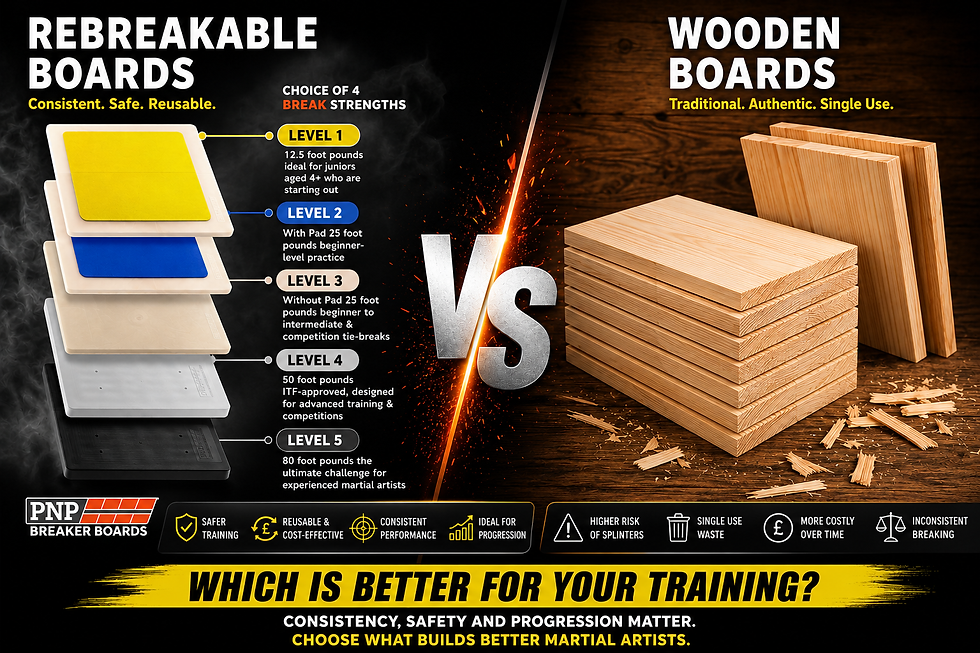
Martial arts breaking is more than just power. It is a test of precision, timing, confidence, technique, focus, and mental discipline. Whether you train in Taekwon-Do, Karate, Kung Fu, or another striking martial art, the type of board you use during training can significantly impact both safety and progression.
For decades, traditional wooden boards have been used as the benchmark for breaking practice and grading demonstrations. However, modern rebreakable boards are rapidly becoming the preferred option for schools, instructors, competitors, and professional martial artists worldwide.
So, when comparing Wooden vs Rebreakable Boards, which option is actually better for martial arts training?
In this guide, we compare the advantages and disadvantages of both and explain why many martial arts schools are now transitioning to reusable breaking solutions such as PNP Breaker Boards.
Understanding Wooden Breaking Boards
Traditional wooden breaking boards are typically made from pine or similar softwoods and are designed to split under impact.
They are commonly used for:
Gradings
Demonstrations
Competition breaking
Traditional martial arts training
Power testing
Wooden boards offer an authentic breaking experience and provide the psychological satisfaction of performing a “real” break.
Advantages of Wooden Boards
Traditional Martial Arts Feel
Many martial artists appreciate the heritage and authenticity associated with wooden breaking.
Wooden boards are deeply embedded within traditional martial arts culture and remain popular for demonstrations and ceremonial events.
Unpredictability Tests Accuracy
Wood can vary in density, grain direction, moisture content, and quality. This unpredictability can challenge advanced martial artists and sharpen focus under pressure.
Single-Use Psychological Commitment
Because wooden boards cannot be reused once broken, students often commit fully to the technique, which can help develop confidence and decisiveness.
The Downsides of Wooden Breaking Boards
While wooden boards have tradition on their side, they also create several practical and safety issues during regular training.
Inconsistent Breaking Resistance
No two wooden boards are exactly the same.
Differences in:
Grain direction
Knots
Moisture levels
Storage conditions
Wood quality
can all affect breaking performance.
This inconsistency can make progression difficult, especially for beginners.
A failed break is not always caused by poor technique; sometimes, the board itself is the issue.
Higher Injury Risk
Wooden boards can splinter or crack unpredictably, increasing the risk of:
Cuts
Bruising
Hand injuries
Finger injuries
Confidence loss after failed attempts
For younger students and beginners, repeated failed attempts at breaks can be discouraging.
Expensive Over Time
Wooden boards are single-use.
That means schools and instructors must continually purchase replacements for:
Gradings
Regular classes
Competitions
Demonstrations
Over time, these ongoing costs add up significantly.
Environmental Waste
Broken wooden boards often end up discarded after a single use.
For schools running multiple classes each week, this creates considerable material waste.
What Are Rebreakable Boards?
Rebreakable boards are engineered polymer training boards that split apart under impact and then reconnect for repeated use.
Modern rebreakable systems, such as PNP Breaker Boards, are designed to replicate the feel and resistance of traditional breaking while offering greater consistency and safety.
They are widely used by:
Martial arts schools
World-level competitors
Demonstration teams
Instructors
Beginner programmes
Tournament organisers
Advantages of Rebreakable Boards
Consistent Breaking Performance
One of the biggest advantages of rebreakable boards is consistency.
Following the initial settling-in period, PNP Breaker Boards deliver highly consistent break performance and are designed to withstand approximately 100 successful breaks under normal training and competition use.
Each board delivers predictable resistance every time, allowing students to:
Develop technique progressively
Build confidence safely
Measure genuine improvement
Train more effectively
Consistency is especially important for junior martial artists and structured grading systems.
Safer for Regular Training
High-quality rebreakable boards feature:
Rounded edges
Controlled separation
Durable engineering polymers
Reduced splintering risk
This creates a safer training environment compared to traditional wood.
For instructors teaching large classes, safety and reliability are critical.
Cost-Effective Long-Term
Although rebreakable boards have a higher upfront cost, they can be reused 100 times.
This dramatically reduces:
Ongoing board replacement costs
Waste
Ordering frequency
Storage requirements
For schools running regular breaking sessions, rebreakable boards often become the more economical option over time.
Better for Skill Progression
Most professional rebreakable systems are available in different strength levels, allowing martial artists to progress gradually.
For example, PNP Breaker Boards offer multiple resistance options:
This progression system helps students:
Develop confidence
Refine technique
Train safely
Increase power systematically
Ideal for High-Volume Training
Rebreakable boards are particularly useful for:
Instructor-led classes
Seminar environments
Competition preparation
Demonstration rehearsals
Frequent impact training
Instead of continually replacing broken wood, instructors can focus on coaching and progression.
Do Rebreakable Boards Feel Realistic?
One of the most common questions instructors ask is whether rebreakable boards “feel” realistic compared to wood.
The answer largely depends on quality.
Cheap, rebreakable boards can feel artificial or overly easy to break.
However, high-quality systems like PNP Breaker Boards are specifically engineered to replicate realistic resistance and consistent impact performance.
In fact, many elite martial artists now train primarily with rebreakable systems before transitioning to wood for demonstrations or grading events.
Which Option Is Better for Beginners?
For beginners, rebreakable boards are generally the better option.
Why?
Because they help students:
Build confidence gradually
Learn correct striking technique
Reduce fear of injury
Experience early success
Train more frequently
A positive first breaking experience is hugely important for long-term student confidence and retention.
Which Option Is Better for Advanced Martial Artists?
Advanced practitioners often benefit from using both systems.
Rebreakable Boards for:
Repetition
Technique refinement
Power development
Competition preparation
Injury reduction
Wooden Boards for:
Demonstrations
Traditional grading experiences
Psychological challenge
Event realism
Many world-level competitors combine both training methods depending on their goals.
Why More Martial Arts Schools Are Switching to Rebreakable Boards
Across Europe and internationally, martial arts schools are increasingly moving toward reusable systems because they offer:
Better consistency
Improved safety
Lower long-term costs
Reduced waste
Easier progression
Professional presentation
Reliable training outcomes
Modern martial arts instruction increasingly focuses on structured progression and injury prevention — areas where rebreakable systems excel.
Why Choose PNP Breaker Boards?
PNP Breaker Boards are trusted by martial artists, instructors, and competitors worldwide.
Key features include:
ITF Approved
Multiple resistance strengths
Durable engineering polymer construction
Rounded safety edges
Consistent breaking performance
Reusable design
Suitable for beginners through to elite competitors
PNP Breaker Boards have also been used at world-level Taekwon-Do events and by international competitors, including Kevin Jansen and Brendan Doogan.
Final Verdict: Wooden vs Rebreakable Boards
Both wooden and rebreakable boards have a place within martial arts training.
However, for most modern schools and regular training environments, rebreakable boards offer clear advantages in:
Safety
Consistency
Cost efficiency
Skill progression
Convenience
Wooden boards still retain their value for tradition and demonstrations, but rebreakable systems have become the preferred day-to-day training solution for many instructors and competitors worldwide.
If you are looking for a safer, more consistent, and professional breaking solution, rebreakable boards are likely the smarter long-term investment.
Frequently Asked Questions
Are rebreakable boards better than wooden boards?
Rebreakable boards offer better consistency, safety, and long-term value for regular martial arts training, while wooden boards are often preferred for demonstrations and tradition.
Do rebreakable boards feel like real wood?
High-quality rebreakable boards are designed to replicate the realistic resistance and impact performance of wooden boards.
Are rebreakable boards safe for children?
Yes. Rebreakable boards are widely used in junior martial arts training because they reduce the risk of splinters and allow safer progression.
How long do rebreakable boards last?
High-quality rebreakable boards can typically withstand 100 successful breaks when used correctly.
What strength rebreakable board should beginners use?
Beginners usually start with lower-resistance boards, such as 12.5 ft-lb or 25 ft-lb, depending on age, technique, and experience level.
Ready to Upgrade Your Breaking Training?
Explore the full range of professional reusable boards at PNP Breaker Boards and discover why martial artists around the world are switching from wood to rebreakable systems.


Comments