
The Science Behind Successful Board Breaking


At the highest levels of competitive Taekwon-Do, successful board breaking requires far more than physical strength. Athletes such as PNP-sponsored competitor Kevin Jansen demonstrate how speed, precision, body mechanics and technique combine to deliver powerful breaking performances.
Understanding the physics, biomechanics and technique that turn a powerful strike into a successful break.
Board breaking is one of the most recognisable demonstrations of skill in martial arts. Whether performed during Taekwon-Do training, a grading examination or a competitive power-breaking event, a successful break represents far more than physical strength.
Behind every effective strike lies a combination of speed, momentum, accuracy, body mechanics and controlled force.
Understanding the science of board breaking can help martial artists develop better technique, train more consistently and approach each breaking challenge with greater confidence.
So, what actually happens when a martial artist breaks a board, and why do some strikes succeed while others fail?
1. The Physics of Board Breaking: Force, Speed and Momentum
At its simplest, board breaking involves transferring energy from a moving hand or foot into a target.
For a board to break, the strike must create sufficient stress to overcome the board's resistance.
Three important scientific principles help explain this process.
Speed and Kinetic Energy
Kinetic energy is the energy an object possesses because of its movement.
The relationship is expressed as:
Kinetic Energy = ½ × Mass × Velocity²
This means that kinetic energy increases with the square of velocity.
For example, doubling the speed of a moving object, while keeping its mass constant, increases its kinetic energy fourfold.
In martial arts, this helps explain why a fast, well-executed strike can be more effective than a slower movement that relies primarily on muscular strength.
However, the speed of the striking hand or foot is only part of the equation. Effective body alignment and the transfer of energy into the target are equally important.
Momentum and Effective Mass
Momentum describes the quantity of motion possessed by a moving object.
Momentum = Mass × Velocity
During a breaking technique, the martial artist uses coordinated movement to bring more than just the hand or foot into the strike.
The hips, torso, shoulders and supporting limbs can all contribute to the movement, depending on the technique being performed.
When these movements are properly coordinated, they can increase the effective mass behind the strike and improve momentum transfer.
This is one reason why whole-body technique is so important in Taekwon-Do and other striking martial arts.
Impact Force
When a strike makes contact with a board, momentum changes over a short period of time.
The average impact force depends on how much momentum changes and how quickly that change occurs.
A correctly delivered strike can generate substantial force during this brief contact.
However, the force required to break a board is not a single universal number. It depends on the material, construction, support conditions and direction of loading.
The key lesson: Successful board breaking is not simply about hitting harder. It is about generating and transferring energy effectively.
2. Why Technique Matters More Than Strength Alone
Physical strength contributes to breaking performance, but strength without technique can lead to inefficient strikes.
Successful martial arts board breaking depends on the coordinated movement of the body, often described as the kinetic chain.
Understanding the Kinetic Chain
The kinetic chain refers to the way different body segments work together to produce movement and transfer force.
For example, during a powerful hand technique:
The feet provide a stable connection with the ground.
The legs and hips help generate and control movement.
The torso transfers and coordinates rotational energy.
The shoulder and arm guide the strike.
The hand delivers the final contact.
When these movements are correctly sequenced, the strike becomes more efficient.
Poor coordination, unnecessary tension or incorrect alignment can reduce the energy delivered to the board.
Body Alignment and Stability
Correct alignment helps direct force through the intended striking surface while maintaining joint stability.
A powerful strike delivered at an awkward angle may waste energy or place unnecessary stress on the wrist, elbow, ankle or other joints.
For this reason, instructors place considerable emphasis on stance, posture, balance and striking-surface preparation before progressing to more demanding breaking exercises.
3. The Importance of Accuracy and the Point of Impact
Speed and power alone do not guarantee a successful break.
Where and how the strike contacts the board can make a significant difference.
Why the Target Area Matters
In a traditionally supported wooden board, a correctly positioned strike near the centre can create bending stresses that contribute to fracture.
The exact behaviour depends on the board's dimensions, grain direction and how it is supported.
Rebreakable martial arts boards work differently.
Rather than fracturing the material, they are designed with a mechanical joining system that separates when the appropriate loading conditions are reached.
For reusable boards, successful breaking therefore depends on applying sufficient force in the correct direction to release the joining mechanism.
Concentrating the Strike
The striking surface also affects how force is distributed.
Different martial arts techniques use specific striking surfaces, such as the forefist, knife-hand or ball of the foot.
Using the correct surface helps the practitioner deliver the technique as intended.
Accuracy should always be developed under qualified instruction, particularly when introducing more advanced breaking techniques.
Training takeaway: A precisely delivered strike with good alignment is generally more effective than an uncontrolled strike relying on strength alone.
4. Follow-Through: Why Commitment to the Technique Matters
One of the most common challenges in board breaking is hesitation immediately before impact.
A martial artist may generate good speed during the initial movement but begin slowing down as the striking surface approaches the board.
This reduces the energy available at contact.
Understanding Follow-Through
In martial arts, instructors often encourage students to visualise a target beyond the surface of the board rather than stopping their movement at the point of contact.
The purpose is to encourage a committed technique with appropriate acceleration, alignment and movement through the intended striking path.
Follow-through does not mean using uncontrolled force or extending joints beyond their safe range.
It means maintaining the mechanics of the technique rather than deliberately decelerating before impact.
Developing this commitment requires repetition, confidence and appropriate progression.
For practical guidance, read our related article, How to Break a Board Properly (Step-by-Step).
5. The Science of Resistance: Why Different Boards Break Differently
Not every martial arts breaking board presents the same level or type of resistance.
Traditional wooden boards and modern rebreakable boards behave differently under impact.
Traditional Wooden Boards
Wooden breaking boards typically fail when the stresses produced by a strike exceed the strength of the material.
Factors influencing the break include:
Wood species and grain orientation.
Board thickness and dimensions.
Moisture content and material condition.
Position and method of support.
Direction, speed and location of the strike.
Because wood is a natural material, differences between individual boards can affect the force needed for a successful break.
Rebreakable Martial Arts Boards
Rebreakable boards use an engineered joining mechanism that separates when sufficient force is applied.
Unlike wooden boards, the intention is not to fracture the material permanently.
Once separated, the two sections can be reassembled for further use.
This makes rebreakable boards particularly useful for repetitive training, where instructors want students to practise techniques without consuming a new wooden board each time.
However, not all rebreakable boards behave identically.
Their resistance depends on their design, construction, condition and the way they are used.
Why Consistency Matters
Consistent training resistance allows martial artists to concentrate on developing technique rather than constantly adapting to unpredictable equipment.
At PNP Breaker Boards, our reusable boards are designed to deliver consistent resistance throughout repeated training sessions. Following an initial settling-in period of approximately 3–4 breaks, they provide reliable performance for around 100 breaks, helping martial artists focus on developing their technique, accuracy and power.
Our range offers different resistance levels, allowing instructors to select equipment appropriate to the student's experience, technique and training objectives.
For a more detailed comparison, explore Wooden vs Rebreakable Boards: Which Is Better for Martial Arts Training?
6. The Role of Repetition and Motor Learning
Board breaking is not simply a test of physical performance. It is also a learned motor skill.
Motor learning describes how the nervous system develops and refines movement through practice and experience.
When a martial artist repeatedly performs a technique, the brain and nervous system gradually become better at coordinating the required movements.
Building Efficient Movement Patterns
With appropriate repetition, students can improve:
Timing and coordination.
Balance and stability.
Accuracy of the striking surface.
Control of speed and movement.
Confidence in executing the technique.
However, repetition alone does not guarantee improvement.
Practising incorrect technique repeatedly can reinforce inefficient movement patterns.
This is why instructor feedback, progressive difficulty and deliberate practice are so valuable.
Why Progressive Resistance Works
Training with an appropriate level of resistance allows students to concentrate on developing correct movement before attempting more demanding breaks.
As technique, control and confidence improve, instructors can introduce greater resistance where appropriate.
PNP Breaker Boards offer a graduated range of resistance levels to support this progression, from introductory breaking practice through to advanced power-breaking training.
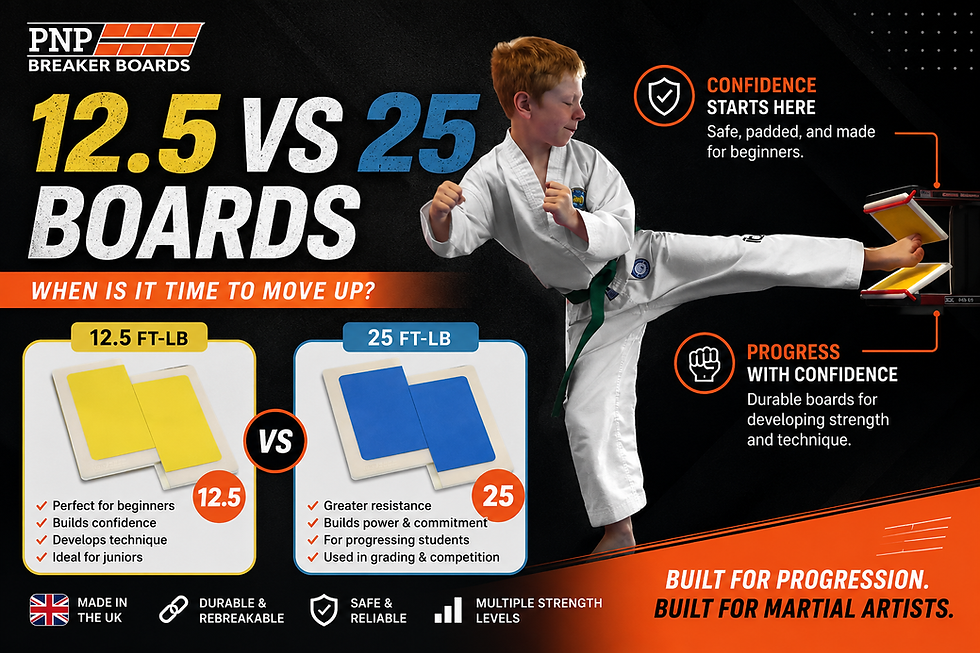
Discover more in our blog, Board Breaking Progression: When Is It Time to Move from 12.5 to 25 Boards?
7. The Psychology of a Successful Break
There is also a psychological component to board breaking.
A martial artist may possess the physical ability to complete a break but struggle because of hesitation, uncertainty or fear of impact.
These responses can affect movement speed, muscle tension and overall coordination.
Confidence Through Preparation
Confidence is most effectively developed through appropriate preparation and successful training experiences.
Students who understand the technique, trust their equipment and have practised under suitable conditions are often better prepared to commit to the movement.
Mental rehearsal and visualisation may also support performance when combined with physical practice.
For instructors, the aim should be to create a controlled learning environment where students can develop confidence without being pressured into attempting breaks beyond their ability.
8. Applying the Science to Your Board-Breaking Training
Understanding the scientific principles behind breaking can help instructors and martial artists approach training more systematically.
Here are five practical considerations:
1. Prioritise technique before resistance.Develop correct stance, alignment and striking mechanics before progressing to more challenging boards.
2. Train speed and coordination together.Focus on smooth, efficient movement rather than relying solely on muscular effort.
3. Improve accuracy through controlled practice.Develop consistency in striking-surface placement and direction of contact.
4. Use appropriate, consistent equipment.Select breaking boards that match the practitioner's level and intended training technique.
5. Progress gradually and review performance.Use instructor feedback to identify improvements in timing, balance, confidence and control.
Breaking practice should always take place under suitable supervision, with correctly supported equipment and appropriate attention to safety.
9. How PNP Breaker Boards Support Scientific Training Principles
At PNP Breaker Boards, we understand the importance of reliable, repeatable training equipment.
Our UK-manufactured rebreakable martial arts boards are designed to support progressive training across a range of abilities.
The PNP range includes:
12.5 Resistance – Natural with Pad: An introductory resistance option for developing breaking skills.
25 Resistance – Natural: A progression option for students building technique and power.
25 Resistance – Natural with Pad: The same resistance category with a padded striking surface.
50 Resistance – White: A higher-resistance option for experienced martial artists and advanced breaking practice.
80 Resistance – Black: Our highest-resistance option, intended for suitably trained, advanced practitioners.
Our boards are reusable and designed for repeated training. A short settling-in period of approximately three to four breaks is recommended before evaluating their normal working resistance.
With appropriate use and care, PNP Breaker Boards are designed to deliver consistent performance for approximately 100 breaks.
The result is a practical training tool that allows instructors and students to focus on technique, progression and performance.
Conclusion: Successful Breaking Is About More Than Power
The science behind successful board breaking demonstrates that physical strength is only one part of the equation.
Speed, momentum, body mechanics, accuracy, confidence and equipment resistance all influence the outcome of a breaking technique.
By understanding these principles, martial artists can train more purposefully, refine their skills and develop greater consistency.
Whether you're introducing a student to their first break or preparing an experienced competitor for a power-breaking event, the objective remains the same: combine effective technique with controlled power and appropriate preparation.
Train with Confidence. Break with Consistency.
Frequently Asked Questions About the Science of Board Breaking
1. What is the science behind breaking boards in martial arts?
The science of board breaking involves physics, biomechanics and the transfer of energy. A successful martial arts board break requires a combination of speed, momentum, correct body alignment and accurate striking technique. When sufficient force is delivered in the correct direction, the board either fractures, in the case of traditional wooden boards, or separates at its joining mechanism, as with rebreakable martial arts boards.
2. Is speed or strength more important for successful board breaking?
Both speed and strength contribute to successful board breaking, but technique plays a crucial role. Increasing striking speed can significantly increase kinetic energy, while correct body mechanics help transfer that energy effectively into the board. A fast, accurate and well-coordinated strike can therefore be more effective than relying on muscular strength alone.
3. Why is accuracy important in Taekwon-Do board breaking?
Accuracy ensures that force is delivered to the intended target area and in the correct direction. During Taekwon-Do board breaking, poor alignment or an incorrectly positioned strike can reduce the effectiveness of the technique. Developing accuracy alongside speed, balance and coordination helps martial artists achieve more consistent breaking performance.
4. How do rebreakable martial arts boards work?
Rebreakable martial arts boards use a specially designed joining mechanism that separates when sufficient force is applied. Unlike traditional wooden boards, they do not need to fracture permanently and can be reassembled for repeated use. PNP Breaker Boards are designed to provide consistent training resistance following an initial settling-in period of approximately 3–4 breaks, with reliable performance for around 100 breaks when used correctly.
5. How can martial artists improve their board-breaking technique?
Martial artists can improve their board-breaking technique by focusing on body alignment, striking accuracy, speed, coordination and controlled follow-through. Practising with appropriate resistance levels and receiving feedback from a qualified instructor can help develop more efficient movement patterns. Rebreakable boards are particularly useful for repeated practice and progressive martial arts training.
6. What resistance level should I choose for martial arts board-breaking training?
The appropriate board resistance depends on the martial artist's experience, physical ability, technique and training objectives. PNP Breaker Boards offer graduated resistance options, including 12.5 Natural with Pad, 25 Natural, 25 Natural with Pad, 50 White and 80 Black. This allows instructors to select suitable equipment for introductory training, technical development and more advanced power-breaking practice.
Explore the PNP Breaker Boards range to find the right resistance level for your martial arts training.


Comments