
Board Breaking Progression: When Is It Time to Move from 12.5 to 25 Boards?

Understanding board breaking progression is essential for students who want to develop confidence, technique, and power safely.
Progression is a key part of martial arts development. Moving to a harder board too early can damage confidence, while staying at the same level for too long can slow your progress.
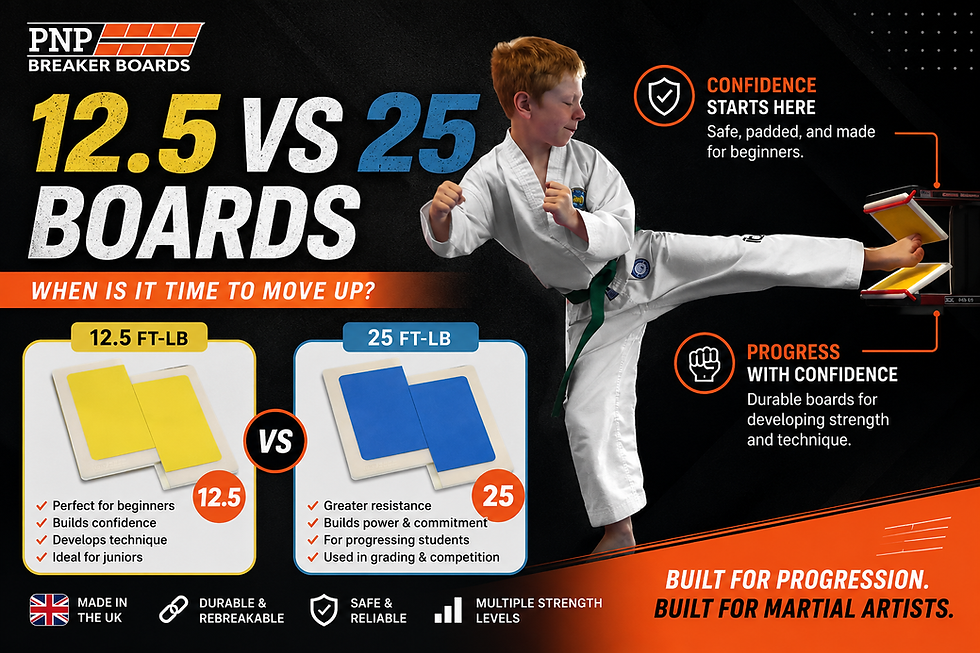
Understanding the difference between 12.5 vs 25 boards can help students, instructors, and clubs create a safer and more effective breaking programme.
If you're still learning the fundamentals, our guide on how to break a board properly explains the key techniques that build confidence and consistency.
In this guide, we'll look at the differences between the two board strengths, how to know when you're ready to move up, and how to make the transition successfully.
12.5 vs 25 Boards: What's the Difference?
The biggest difference between 12.5 vs 25 boards is the amount of force required to achieve a successful break.
Designed for:
Beginners
Junior martial artists
Confidence building
First-time breakers
Technique development
These boards provide an excellent introduction to board breaking and allow students to focus on form rather than power.
Designed for:
Progressing students
Intermediate breakers
Competition preparation
Power development
Advanced confidence building
A 25 board requires greater commitment and cleaner technique, making it the natural next step after mastering the 12.5.
Why Board Breaking Progression Matters
Many martial artists assume progression is simply about breaking harder boards.
In reality, proper progression develops:
✔ Better technique
✔ Greater confidence
✔ Improved accuracy
✔ Stronger commitment
✔ Safer training habits
When comparing 12.5 vs 25 boards, the goal is not simply to break a stronger board but to improve overall martial arts performance.
Sign #1: You're Breaking the 12.5 Board Consistently
One successful break doesn't necessarily mean you're ready to move up.
Instead, ask yourself:
Can I break it every time?
Can I break it under pressure?
Can I break it using different techniques?
Am I confident before each attempt?
Consistency is often the clearest sign that it's time to progress.
Sign #2: Your Technique Is Reliable
Board breaking should be driven by technique rather than strength.
Before progressing, your instructor should see:
Good body alignment
Strong balance
Correct striking surfaces
Effective follow-through
Controlled movement
The jump from 12.5 vs 25 boards exposes technical weaknesses much more quickly.
Sign #3: You No Longer Hesitate
Confidence plays a huge role in breaking success.
Students who are ready for a 25 board typically:
Commit fully to techniques
Trust their ability
Strike through the target
Show confidence before impact
If hesitation has disappeared from your breaking, progression may be appropriate.
Sign #4: Your Instructor Recommends It
An experienced instructor can often spot readiness before the student does.
They can identify:
Technical flaws
Timing issues
Confidence levels
Consistency
Their guidance is often the best indicator of whether it's time to move up.
Should You Move Straight to a Natural 25 Board?
Not always.
Many students benefit from moving to a:
before progressing to a:
This creates a smoother transition and allows confidence to build gradually.
For many clubs, the blue 25 ft-lb padded board becomes the bridge between beginner and intermediate breaking.
Common Mistakes When Moving Up
Progressing Too Soon
Moving up before you're ready often leads to:
Failed breaks
Frustration
Loss of confidence
Poor habits
If you're struggling with unsuccessful attempts, read our guide on why your board isn't breaking to identify common mistakes and improve your technique.
Focusing on Strength
Board breaking is not about hitting harder.
Successful breaks rely on:
Technique
Timing
Speed
Commitment
Follow-through
Losing Confidence After One Failed Attempt
Many students assume a failed break means they aren't ready.
It doesn't.
Failed attempts are part of the learning process and often provide valuable feedback.
Why Rebreakable Boards Are Perfect for Progression
One of the biggest advantages of rebreakable boards is consistency.
Unlike wood, they provide predictable resistance every time.
Learn more about the advantages of reusable training equipment in our article comparing wooden vs rebreakable boards for martial arts training.
This allows students to:
Measure progress accurately
Build confidence gradually
Practise repeatedly
Progress safely
Professional systems such as PNP Breaker Boards provide multiple strength levels that support structured development.
Which Board Should You Choose?
Stay with 12.5 if:
You're new to board breaking
Confidence is still developing
Technique needs refinement
Move to 25 if:
You consistently break 12.5 boards
Technique is reliable
Confidence is high
Your instructor recommends progression
Final Thoughts on 12.5 vs 25 Boards
Understanding 12.5 vs 25 boards is one of the most important aspects of board breaking progression.
Students should move up when they demonstrate:
✔ Consistency
✔ Confidence
✔ Good technique
✔ Strong follow-through
✔ Instructor approval
The goal isn't simply to break harder boards.
The goal is to become a better martial artist.
Ready to Take Your Board Breaking to the Next Level?
Whether you're building confidence with a 12.5 board or preparing to step up to a 25, having the right equipment can make all the difference.
PNP Breaker Boards are trusted by martial arts clubs, instructors, and competitors worldwide for their consistent break forces, durable construction, and structured progression pathway.
Explore our full range of UK-made rebreakable boards and find the perfect strength level for your next challenge.
Build Confidence.
Develop Technique.
Progress with Purpose.
Shop PNP Breaker Boards today and take the next step in your martial arts journey.
Frequently Asked Questions
1. What is the difference between a 12.5 board and a 25 board?
The main difference between a 12.5 board and a 25 board is the amount of force required to achieve a successful break. A 12.5 ft-lb board is ideal for beginners and juniors, while a 25 ft-lb board is designed for progressing students who have developed greater confidence, technique, and commitment.
2. When should I move from a 12.5 board to a 25 board?
You should consider moving from a 12.5 board to a 25 board when you can consistently break the 12.5 board with good technique, strong follow-through, and confidence. Instructor guidance is also important when deciding if you're ready to progress.
3. Is a 25 board suitable for junior martial artists?
Yes. Many junior martial artists successfully progress to a 25 board once they have mastered the fundamentals of board breaking. The key factors are technique, confidence, and consistency rather than age alone.
4. Are rebreakable boards better for progression?
Rebreakable boards are ideal for progression because they provide consistent resistance and can be used repeatedly. This allows students to build confidence, improve technique, and progress through different board strengths in a structured way.
5. Can I move straight from a 12.5 board to a natural 25 board?
Some students can, but many benefit from first using a 25 ft-lb board with a pad. This provides a smoother transition and helps build confidence before progressing to higher resistance levels used in competition and advanced training.


Comments