
Breaking Progression for Junior Martial Artists: Building Confidence Through Board Breaking

For many young martial artists, successfully breaking a board is one of the most exciting milestones in their training journey.
It's not just about power or earning a new belt. Board breaking teaches confidence, focus, commitment, and perseverance—skills that benefit children both inside and outside the dojo.
The key is ensuring that board breaking progression happens in a safe, structured, and age-appropriate way.
In this guide, we'll explore how junior martial artists develop breaking skills, why progression matters, and how instructors can help young students build confidence through achievable goals.

Why Board Breaking Is Important for Junior Martial Artists
When introduced correctly, board breaking offers much more than a physical challenge.
It helps young martial artists develop:
✔ Self-confidence
✔ Goal-setting skills
✔ Focus and concentration
✔ Commitment to technique
✔ Trust in their training
✔ A sense of achievement
For many children, their first successful board break becomes a defining moment in their martial arts journey.
Confidence Comes Before Power
One of the biggest misconceptions about board breaking is that it requires strength. In reality, younger students often succeed because they learn to focus on technique rather than force. A confident student with good mechanics will usually perform better than a stronger student who hesitates. Building confidence starts with learning the fundamentals. Our guide on how to break a board properly explains the key techniques that help junior martial artists achieve consistent breaking success.
Creating a Structured Progression Pathway
Breaking Progression for Junior Martial Artists Starts with Confidence
Children learn best when challenges increase gradually. Rather than jumping straight into difficult breaks, instructors should create a progression pathway that allows students to experience regular success.
A typical progression programme might include:
Stage 1: Target Training
Students learn:
Accuracy
Focus
Balance
Body positioning
No breaking is involved at this stage.
Stage 2: Introduction to Breaking
Students are introduced to beginner-friendly breaking boards designed to reward good technique.
The emphasis remains on:
Commitment
Follow-through
Confidence
Rather than power.
Stage 3: Consistent Success
Students practise breaking regularly and develop trust in their abilities.
At this stage, many young martial artists begin to understand that technique creates results.
Stage 4: Increased Challenge
As confidence grows, students can progress to higher resistance levels and more advanced techniques.
This creates new goals while maintaining a positive learning experience.
The Role of Goal Setting
Children thrive when they have clear goals to work towards.
Board breaking provides visible milestones that students can measure and celebrate.
Examples include:
First successful hand technique break
First kicking break
Breaking consistently
Progressing to a higher board strength
Demonstration or grading breaks
These achievements help maintain motivation and engagement.
Why Consistency Matters More Than Difficulty
Some instructors feel pressure to increase difficulty quickly.
However, successful junior programmes focus on consistency before progression.
A child who can break the same board consistently is developing:
Confidence
Technique
Mental resilience
Reliable mechanics
Those foundations are more valuable than rushing to harder boards.
Managing Fear and Nerves
Even confident students can feel nervous before attempting a break.
This is completely normal.
Instructors can help by:
Demonstrating techniques
Celebrating effort as well as success
Creating a positive environment
Encouraging students to trust their training
Reducing fear often leads to better performance and more enjoyable experiences.
If a student experiences a failed break, it's important to remember that setbacks are normal. Understanding common board breaking mistakes can help identify areas for improvement and rebuild confidence.
Building Long-Term Engagement
One of the greatest benefits of structured breaking progression is that it keeps students motivated.
Children enjoy seeing tangible evidence of improvement.
When progression is planned carefully, students remain excited about training and look forward to achieving the next milestone.
This helps improve retention and creates a stronger martial arts programme overall.
Why Rebreakable Boards Are Ideal for Junior Programmes
Rebreakable boards are particularly well suited to junior martial arts training because they provide:
Consistent resistance
Safe progression
Repeatable practice opportunities
Predictable results
Long-term value for clubs
Most importantly, they allow instructors to create confidence-building experiences without constantly replacing equipment.
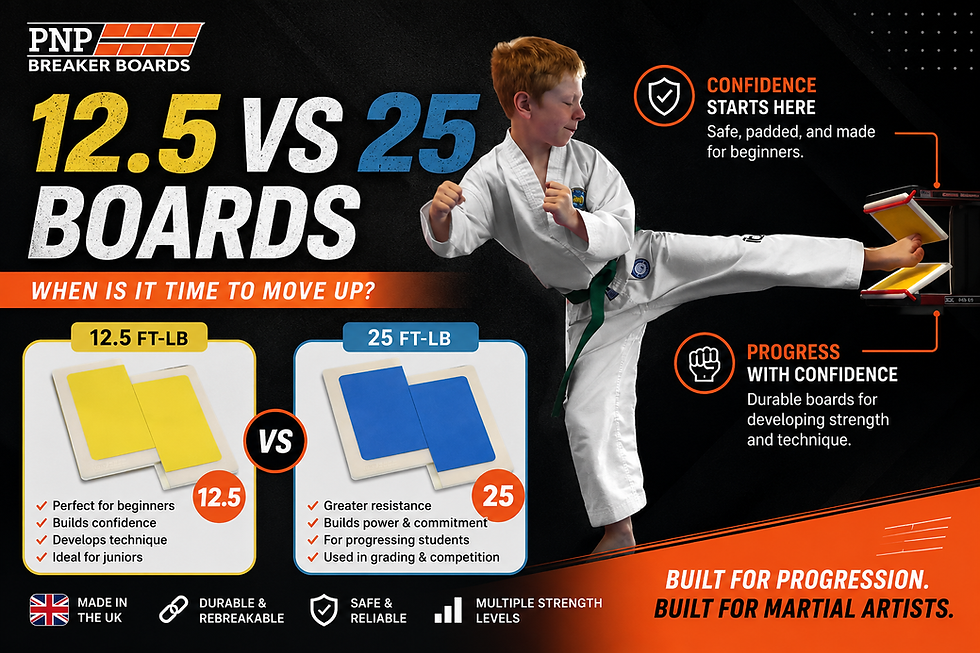
As young martial artists develop, instructors can use different strength levels to support progression. Learn more about when to move up to a 25 board and the signs that a student is ready for the next challenge.
Supporting Parents Through the Journey
Parents often worry that board breaking is intimidating or unsafe.
Explaining the purpose behind progression can help reassure them.
Board breaking is not about encouraging aggression.
It is about helping children develop:
Confidence
Self-belief
Focus
Goal achievement
Resilience
These lessons often extend far beyond martial arts training.
Final Thoughts
Breaking progression for junior martial artists should never be about rushing towards harder boards.
The most successful programmes focus on building confidence first, then technique, then progression.
When students experience regular success, they develop the mindset, skills, and self-belief needed to continue improving throughout their martial arts journey.
With the right guidance and equipment, board breaking becomes one of the most rewarding and memorable parts of a child's martial arts experience.
Ready to Help Your Junior Martial Artists Progress with Confidence?
The right board can make all the difference in a young student's martial arts journey. By providing safe, consistent, and achievable challenges, instructors can help children build confidence, develop technique, and experience the satisfaction of success at every stage of their training.
PNP Breaker Boards are designed to support structured progression, with a range of break strengths suitable for beginners through to advanced martial artists. Durable, reusable, and manufactured in the UK, they're trusted by clubs and instructors around the world.
🥋 Build Confidence🎯 Develop Technique🏆 Celebrate Achievement
Explore the PNP Breaker Boards range today and give your students the tools they need to progress safely, consistently, and with confidence.
Start Their Progression Journey Today
Frequently Asked Questions
What age should children start board breaking?
Many martial arts schools introduce board breaking once students have developed basic technique, coordination, and confidence, often from around age 4–6 depending on the programme.
Is board breaking safe for children?
When supervised correctly and using appropriate equipment, board breaking is a safe and effective way to build confidence and technique.
Do children need strength to break boards?
No. Technique, focus, and commitment are usually far more important than strength.
Why do martial arts schools use rebreakable boards for juniors?
Rebreakable boards provide consistent resistance and allow safe, structured progression without the variability of wooden boards.
How does board breaking help children's confidence?
Successfully achieving a challenging goal helps children develop self-belief, resilience, and trust in their abilities.


Comments